Strengthening Indonesia’s Climate Intelligence Through Mission-Critical Data Center Infrastructure
In an era where timely, data-driven insights can protect communities and save lives, advanced computing systems require more than powerful servers. They depend on a reliable, resilient, and precisely engineered data center environment.
As part of the landmark Maritime Meteorological System Phase 2 (MMS-2) Project, SIBAKOM successfully completed the Data Center Infrastructure Upgrade Work Package at the headquarters of the Indonesian Agency for Meteorology, Climatology, and Geophysics (BMKG) in Kemayoran, Central Jakarta.
The project focused on strengthening the supporting infrastructure required to accommodate BMKG’s expanding High-Performance Computing (HPC), server, Big Data, artificial intelligence, and maritime service systems.
Rather than supplying or developing the computing platforms themselves, SIBAKOM was responsible for ensuring that the surrounding data center environment—including cooling, power, electrical distribution, structural support, and environmental control systems—was ready to support the demanding operational requirements of the newly installed equipment.
Through comprehensive planning, engineering design, installation, integration, testing, and commissioning, SIBAKOM helped establish a stable and resilient foundation for BMKG’s next generation of meteorological operations.
Project Overview: Building the Foundation for Expansion
As weather and climate data continue to grow in volume and complexity, BMKG required additional computing capacity to support more advanced weather modeling, marine forecasting, data processing, and AI-based analysis.
The expansion involved the installation of new Sequana HPC racks, additional server racks, a Big Data and AI platform, and supporting maritime service systems. However, accommodating these systems required significant upgrades to the existing Main Data Center infrastructure.
High-density computing equipment produces substantial heat, consumes considerable electrical power, and places greater physical loads on the data center environment. Without properly designed supporting systems, even the most advanced computing hardware cannot operate safely or reliably.
SIBAKOM therefore undertook the upgrade of the Main Data Center’s supporting infrastructure to ensure that the new computing systems could operate within the required environmental, electrical, and structural conditions.
The work was carefully planned and executed while maintaining the continuity of BMKG’s essential operational services.
Technical Excellence: Infrastructure Delivered by SIBAKOM
To support reliable data center operations around the clock, SIBAKOM implemented an integrated infrastructure solution covering cooling, power availability, structural reinforcement, and electrical distribution.
Advanced Cooling Infrastructure
High-density computing systems generate significant amounts of heat and require stable cooling to maintain optimal performance.
SIBAKOM installed and integrated a heavy-duty chilled-water cooling system featuring two Mitsubishi Climaveneta industrial chillers, automated chiller sequencing controls, high-capacity Ebara chilled-water pumps, and a large water buffer tank.
The system was supported by Stulz Precision Air Conditioning units within the server rooms to maintain controlled temperature and humidity levels around the installed computing equipment.
This cooling infrastructure provides the thermal stability required to support BMKG’s HPC, server, Big Data, and AI environments.
Reliable Power and Parallel UPS Infrastructure
Continuous power availability is critical for BMKG’s operational systems. Even a brief power disruption could interrupt data processing and affect essential meteorological services.
To strengthen power reliability, SIBAKOM installed a new 250 kVA Schneider Uninterruptible Power Supply unit and integrated it with the existing UPS infrastructure.
The synchronized parallel configuration increased the available UPS capacity to approximately 500 kVA, providing clean and uninterrupted electrical power for the newly installed computing and server systems.
This upgrade also improved redundancy and reduced the risk of a single power-system failure affecting data center operations.
Heavy-Duty Structural Support
Next-generation HPC racks are significantly heavier than conventional server equipment and cannot always be safely supported by standard raised-floor structures.
SIBAKOM designed and installed custom heavy-duty steel base frames to support the new Sequana HPC racks.
The frames were engineered according to the physical dimensions, weight distribution, and placement requirements of the equipment, providing a secure structural foundation while protecting the surrounding data center floor system.
Electrical Distribution and Cabling
The addition of HPC racks, server racks, Big Data and AI platforms, and the Maritime Services Gateway System required modifications to the existing electrical distribution network.
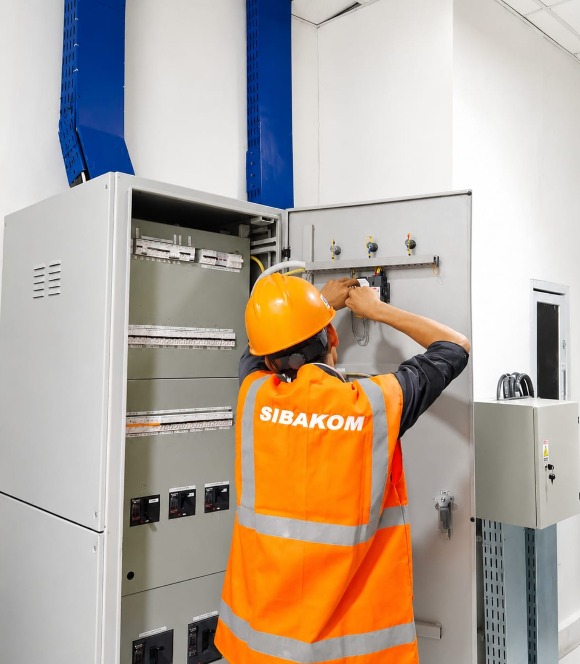
SIBAKOM upgraded and expanded the three-phase power cabling and distribution systems to deliver stable and appropriately balanced electrical power to the new equipment.
The work included cable routing, electrical load distribution, equipment connection, and integration with the upgraded UPS infrastructure.
This ensured that every system received reliable power while maintaining an efficient and balanced electrical environment across the data center.
System Integration and Environmental Readiness
Beyond the installation of individual components, SIBAKOM ensured that the upgraded cooling, power, structural, and electrical systems operated as one integrated infrastructure environment.
Comprehensive inspections and functional testing were conducted to confirm that the Main Data Center was ready to support BMKG’s newly installed computing platforms.
This integrated approach was essential because data center reliability depends not only on the performance of each component, but also on how effectively all supporting systems operate together.
Enabling Better Weather and Climate Services
Although SIBAKOM’s scope centered on supporting infrastructure, its contribution plays an important role in enabling BMKG’s advanced computing systems to operate reliably.
The upgraded data center environment provides the foundation required for BMKG to process large volumes of atmospheric and oceanographic data, run complex forecasting models, and support critical meteorological services.
Supporting Tropical Cyclone Forecasting
Indonesia’s position between the Indian and Pacific Oceans exposes many regions to tropical weather systems and hazardous marine conditions.
By providing a reliable operating environment for BMKG’s computing platforms, the upgraded infrastructure supports the continuous processing required by systems such as the Tropical Cyclone Forecast System.
This enables BMKG’s forecasters to analyze weather developments and produce timely information for affected regions.
Strengthening Marine Weather Services
Millions of Indonesians depend on the sea, including fishermen, coastal communities, port operators, offshore industries, and national and international shipping operators.
Reliable data center infrastructure helps ensure that BMKG’s marine forecasting and warning systems remain operational when processing oceanographic and atmospheric data.
These services are essential for reducing maritime risks, improving voyage planning, and supporting the safety of Indonesia’s blue economy.
Supporting Faster Early-Warning Processes
Extreme rainfall, strong winds, high waves, and other hazardous weather conditions require timely monitoring and analysis.
The upgraded data center infrastructure enables BMKG’s computing and data-processing systems to operate under stable environmental and electrical conditions. This supports the faster transformation of raw observation data into forecasts, analyses, and early-warning information.
By strengthening the systems behind these services, the project contributes to improved national preparedness and more informed decision-making.
A Successful Infrastructure Upgrade
The successful completion of the Site Acceptance Test at BMKG Headquarters confirmed that the upgraded infrastructure met the required technical and operational standards.
The testing covered the performance and integration of the cooling, power, electrical, structural, and supporting environmental systems delivered under SIBAKOM’s scope of work.
This achievement demonstrates SIBAKOM’s ability to execute complex, multidisciplinary data center infrastructure projects in operationally critical environments.
More importantly, it highlights the essential role of supporting infrastructure in ensuring that advanced computing platforms can operate securely, efficiently, and continuously.
Building Resilient Infrastructure for Indonesia’s Future
As meteorological services increasingly rely on Big Data, AI, high-resolution modeling, and other computational technologies, the need for dependable physical infrastructure will continue to grow.
Advanced computing equipment cannot perform effectively without reliable cooling, uninterrupted power, proper structural support, and well-designed electrical distribution systems.
Through the MMS-2 Project, SIBAKOM has demonstrated its capability to deliver the mission-critical infrastructure that supports these advanced technologies.
Moving forward, SIBAKOM remains committed to developing reliable, efficient, and resilient infrastructure solutions for data centers and other critical facilities across Indonesia.
By strengthening the physical foundation behind Indonesia’s climate and weather systems, SIBAKOM contributes to a safer, more resilient, and technologically prepared nation.